
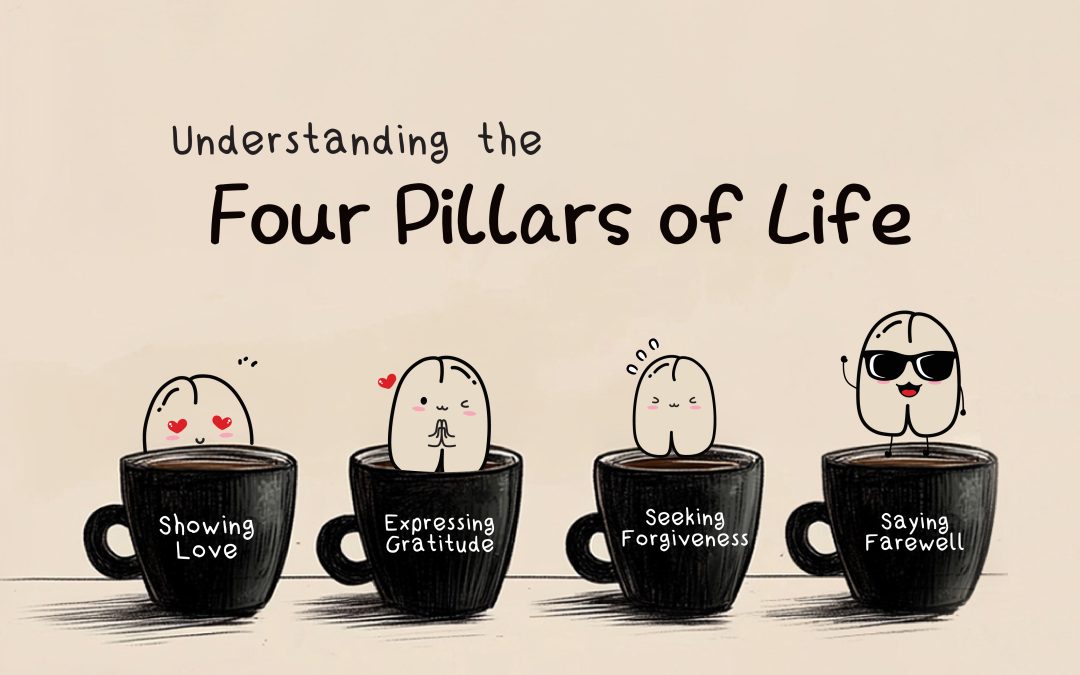
The Four Pillars of Life originally served as a guiding principle for individuals to reflect upon their journey as they come to the end of life. These four essential actions—expressing gratitude, seeking forgiveness, showing love, and saying farewell—were meant to help people find closure and peace before passing. Over time, various associations and organizations have actively promoted these values, encouraging families to support their elders in resolving past grievances and making peace with themselves and the world while they are still lucid and able. This allows them to depart with a heart full of gratitude and without regrets.
From a young age, we often hear these words, “birth, aging, illness and death,” suggesting that life follows a natural order. However, a casual glance at the obituary display updated daily at Nirvana Center Kuala Lumpur’s lift lobby, reveals names that include both men and women, as well as those of the young and the elderly. The shocked and grief-stricken expressions of families caught off-guard arriving at funeral parlours are clear indications that not everyone departs life in a predictable manner. Reflecting on departed loved ones, those who found themselves faced with their own mortality are more often than not overwhelmed. Those who had to watch over them were similarly affected—if not worse—wishing they had expressed more before it was too late. This is why we should begin putting the Four Pillars of Life into practice, regardless of where we are in life—rather than waiting for old age or our final days.
The Four Pillars of Life often appears like a set sequence—starting with “expressing gratitude, seeking forgiveness, showing love,” and with “saying farewell” as the final step. Perhaps it is because goodbyes often evoke a sense of melancholy and regret, that people are reluctant to face it. However, if we view the Four Pillars as a lifelong practice, we should allow each of these four aspects to manifest freely, without the perceived rigid sequencing. This implies that any of the four aspects can be revisited randomly at any time depending on the circumstances and needs of the situation.

The Four Pillars: The Bearing of the Pillars
The Four Pillars of Life—expressing gratitude, seeking forgiveness, showing love and saying farewell—seems simple in theory, yet it is not always easy in practice. For children, these actions come naturally; for adults however, somewhat less so. Polite expressions such as “thank you” or “sorry” exist in our daily interactions, but the difference lies in depth. In casual exchanges, these words convey courtesy; in the Four-Fold Path, they strengthen emotional bonds. This distinction is often why adults, especially those unaccustomed to expressing emotions, struggle to verbalize their feelings, eventually forgetting the importance of these four actions.
What makes the Four Pillars so impactful is not merely saying the words, but ensuring they are spoken at the right time, to the right people, with sincerity. When infused with meaning, these simple phrases become powerful and transformative.
Thus, the Four Pillars is not just about saying “thank you,” “goodbye,” “I’m sorry,” or “I love you.” It can take the form of a heartfelt conversation, a written letter, or even a simple gesture. As long as the speaker is sincere and the listener is receptive, these four actions become the most natural and healing practice in everyday life.
No Regrets, We’ve Always Had the Most Beautiful Moments
Remembering all those we have loved and lost, many of us share the same realisation—we have already shared our last moments with countless people without even knowing it. Every conversation, every exchange, and every interaction may have been the final farewell. It is the words and gestures contained within the Four Pillars that we have shared in daily life that become the most lasting and beautiful images in our memories.
- Express Gratitude – Thank the people, experiences, and moments that have shaped your life.
- Say Farewell – Cherish today’s memories and embrace tomorrow’s uncertainties with peace.
- Show Love – If you love, let it be genuine—break the habit of saying words you don’t mean.
- Seek Forgiveness – Healing begins when we say, “I’m sorry” and “I forgive you,” even for unseen wounds.

Who should pre-plan?
Who should pre-plan? There are people in their 20’s and 30’s considering pre-planning, while there are people in their 40’s and 50’s who may think it’s too early to even think about it. Majority are likely to hold the perception that those in their senior years...

How does pre-planning work?
Pre-planning can be thought of as a preparation strategy of everything connected to your funeral in and pre-paying for it in advance as a pre-need funeral contract

Preparation or taboo?
pre-planning is done out of consideration and care for loved ones and is considered a prudent exercise rooted in logic and economic sensibilities

What is pre-planning?
…pre-planning (sometimes also called “pre-arrangement”, “pre-arrangement planning” or “pre-need planning”) means setting up your funeral…

Pre-planning
Pre-planning We prepare for almost everything in life. To cover for the possibility of accidents and sickness, we have insurance. To get married, couples spend months to years to ensure everything goes right. To safeguard our children’s future education, we...